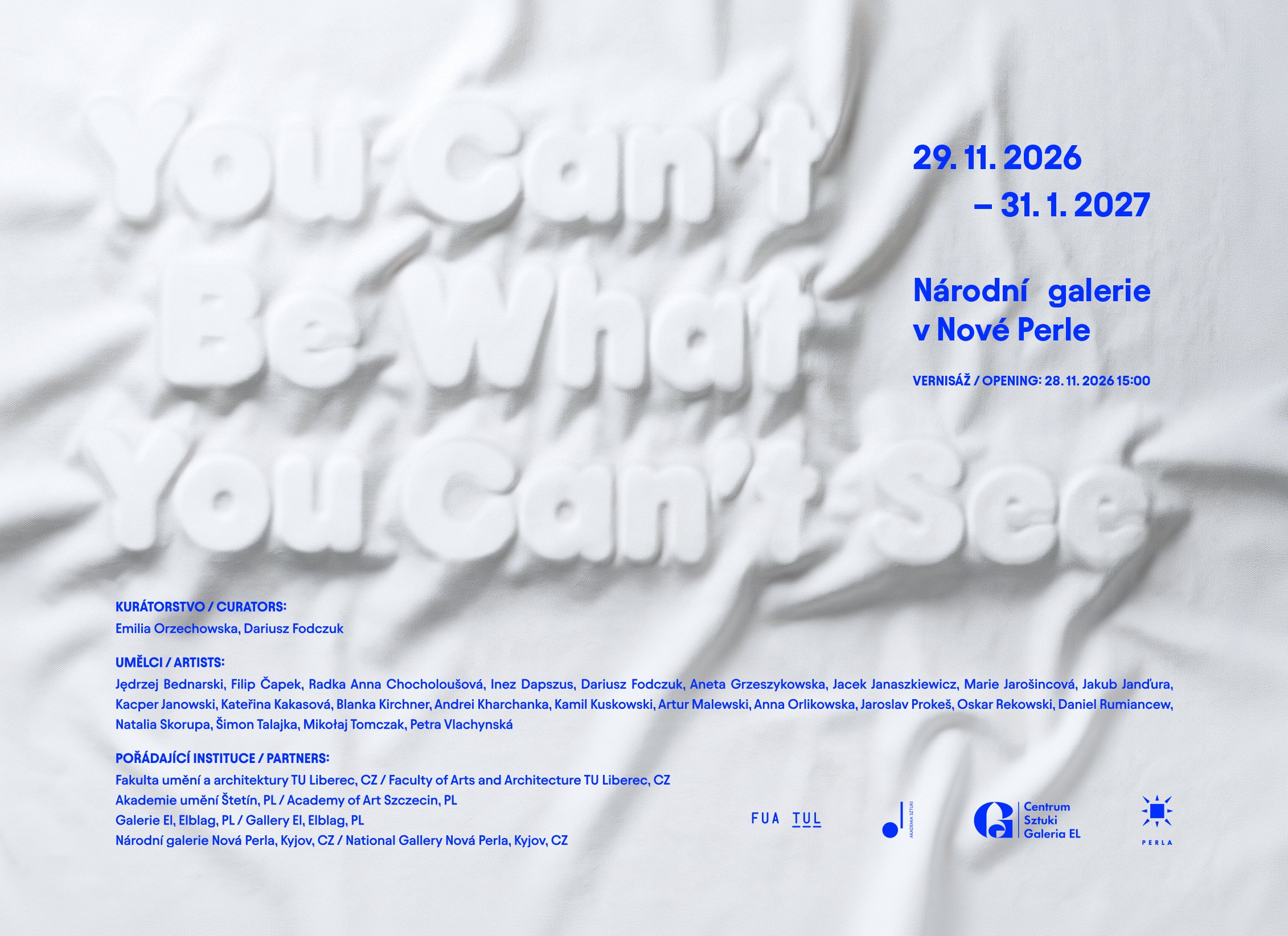
You Can't Be What You Can't See
29. 11. 2026 – 31. 1. 2027
National Gallery Nová Perla
Curators: Emilia Orzechowska, Dariusz Fodczuk
Opening: 28. 11. 2026 at 15:00
Artists: Jędrzej Bednarski, Filip Čapek, Radka Anna Chocholoušová, Inez Dapszus, Dariusz Fodczuk, Aneta Grzeszykowska, Jacek Janaszkiewicz, Marie Jarošincová, Jakub Janďura, Kacper Janowski, Kateřina Kakasová, Blanka Kirchner, Andrei Kharchanka, Kamil Kuskowski, Artur Malewski, Anna Orlikowska, Jaroslav Prokeš, Oskar Rekowski, Daniel Rumiancew, Natalia Skorupa, Šimon Talajka, Mikołaj Tomczak, Petra Vlachynská.
Partners:
Fakulta umění a architektury TU, Liberec, CZ
Akademie umění, Štětín, PL
Galerie El, Elblag, PL
Národní galerie Nová Perla
Addressa: Národní galerie Nová Perla, Kyjov 36, 407 47 Krásná Lípa
Free bus transportation, registration:
https://forms.gle/vz35Wf3FNuodr3DP9
The exhibition You Can’t Be What You Can’t See brings together artists from Poland and the Czech Republic whose practices have grown out of a shared dialogue across borders, generations, and artistic approaches. Through diverse artistic practices, it explores imagination, memory, and our responsibility for the world we shape together. In an age saturated with images and information, imagination becomes not only a source of new visions, but also a way to challenge indifference and seek paths towards empathy and solidarity. The exhibition invites us to reconnect with our capacity to feel, imagine a different future, and turn it into reality.
This collaboration developed through meetings, discussions, and artistic residencies held in Poland and the Czech Republic in 2024–2025, including the International Performance Festival at Galeria Bielska BWA in Bielsko-Biała, the Centre of Polish Sculpture in Orońsko, and the Technical University of Liberec. The project was presented in exhibitions at the National Museum in Szczecin (13 November 2025–1 February 2026) and Galeria EL in Elbląg (12 February 2026 – 12 April 2026) . The current exhibition in Nova Perla, Kyjov continues this exchange and builds on its shared reflection on imagination, memory, and our responsibility for the world we shape together.
The exhibition explores imagination not only as a source of new visions, but also as a way to challenge indifference and seek paths towards empathy and solidarity. As science-fiction writer and archivist Walidah Imarisha asks: “What wisdom and knowledge does the past hold that can help us build the future?” By turning to archives and earlier visions, the artists consider how the past can inspire new ways of imagining what lies ahead. The exhibition invites us to reconnect with our capacity to feel, imagine a different future, and turn it into reality.